

July 3rd, 2026
Bogotá, Colombia
My esteemed economic colleagues,
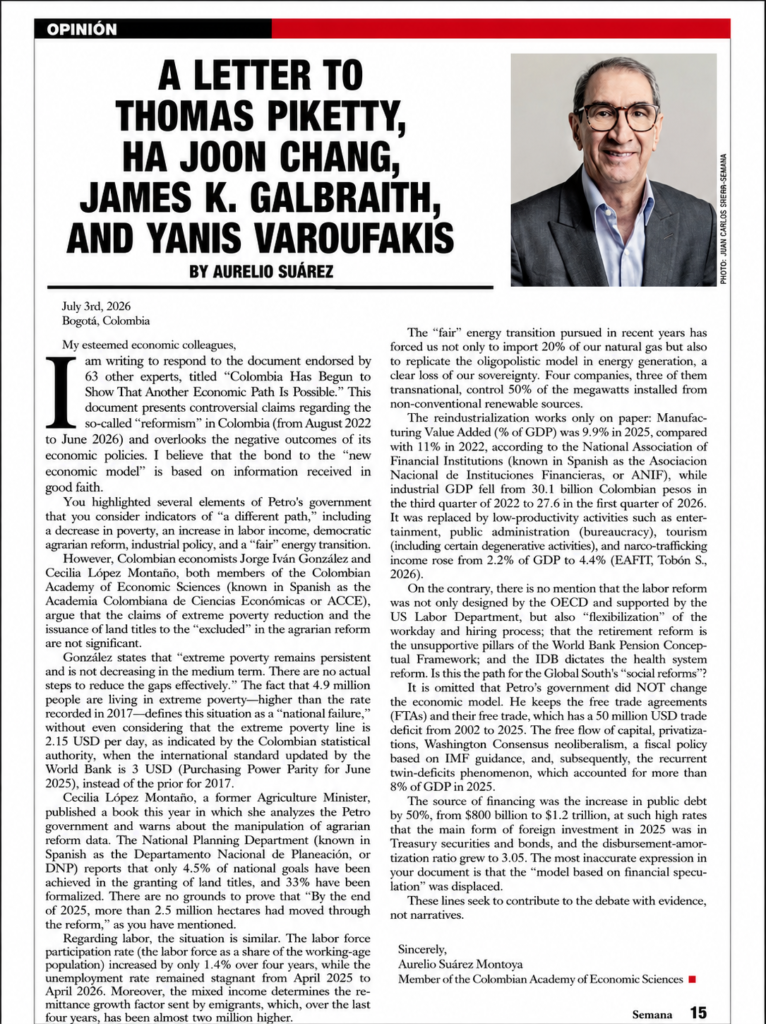
I am writing to respond to the document endorsed by 63 other experts, titled «Colombia Has Begun to Show That Another Economic Path Is Possible.» This document presents controversial claims regarding the so-called «reformism» in Colombia (from August 2022 to June 2026) and overlooks the negative outcomes of its economic policies. I believe that the bond to the «new economic model» is based on information received in good faith.
You highlighted several elements of Petro’s government that you consider indicators of «a different path,» including a decrease in poverty, an increase in labor income, democratic agrarian reform, industrial policy, and a “fair” energy transition.
However, Colombian economists Jorge Iván González and Cecilia López Montaño, both members of the Colombian Academy of Economic Sciences (known in Spanish as the Academia Colombiana de Ciencias Económicas or ACCE), argue that the claims of extreme poverty reduction and the issuance of land titles to the «excluded» in the agrarian reform are not significant.
González states that «extreme poverty remains persistent and is not decreasing in the medium term. There are no actual steps to reduce the gaps effectively.» The fact that 4.9 million people are living in extreme poverty—higher than the rate recorded in 2017—defines this situation as a “national failure,” without even considering that the extreme poverty line is 2.15 USD per day, as indicated by the Colombian statistical authority, when the international standard updated by the World Bank is 3 USD (Purchasing Power Parity for June 2025), instead of the prior for 2017.
Cecilia López Montaño, a former Agriculture Minister, published a book this year in which she analyzes the Petro government and warns about the manipulation of agrarian reform data. The National Planning Department (known in Spanish as the Departamento Nacional de Planeación, or DNP) reports that only 4.5% of national goals have been achieved in the granting of land titles, and 33% have been formalized. There are no grounds to prove that “By the end of 2025, more than 2.5 million hectares had moved through the reform,” as you have mentioned.
Regarding labor, the situation is similar. The labor force participation rate (the labor force as a share of the working-age population) increased by only 1.4% over four years, while the unemployment rate remained stagnant from April 2025 to April 2026. Moreover, the mixed income determines the remittance growth factor sent by emigrants, which, over the last four years, has been almost two million higher.
The “fair” energy transition pursued in recent years has forced us not only to import 20% of our natural gas but also to replicate the oligopolistic model in energy generation, a clear loss of our sovereignty. Four companies, three of them transnational, control 50% of the megawatts installed from non-conventional renewable sources.
The reindustrialization works only on paper: Manufacturing Value Added (% of GDP) was 9.9% in 2025, compared with 11% in 2022, according to the National Association of Financial Institutions (known in Spanish as the Asociacion Nacional de Instituciones Financieras, or ANIF), while industrial GDP fell from 30.1 billion Colombian pesos in the third quarter of 2022 to 27.6 in the first quarter of 2026. It was replaced by low-productivity activities such as entertainment, public administration (bureaucracy), tourism (including certain degenerative activities), and narco-trafficking income rose from 2.2% of GDP to 4.4% (EAFIT, Tobón S., 2026).
On the contrary, there is no mention that the labor reform was not only designed by the OECD and supported by the US Labor Department, but also “flexibilization” of the workday and hiring process; that the retirement reform is the unsupportive pillars of the World Bank Pension Conceptual Framework; and the IDB dictates the health system reform. Is this the path for the Global South’s “social reforms”?
It is omitted that Petro’s government did NOT change the economic model. He keeps the free trade agreements (FTAs) and their free trade, which has a 50 million USD trade deficit from 2002 to 2025. The free flow of capital, privatizations, Washington Consensus neoliberalism, a fiscal policy based on IMF guidance, and, subsequently, the recurrent twin-deficits phenomenon, which accounted for more than 8% of GDP in 2025.
The source of financing was the increase in public debt by 50%, from $800 billion to $1.2 trillion, at such high rates that the main form of foreign investment in 2025 was in Treasury securities and bonds, and the disbursement-amortization ratio grew to 3.05. The most inaccurate expression in your document is that the “model based on financial speculation” was displaced.
These lines seek to contribute to the debate with evidence, not narratives.
Sincerely,
Aurelio Suárez Montoya
Member of the Colombian Academy of Economic Sciences